
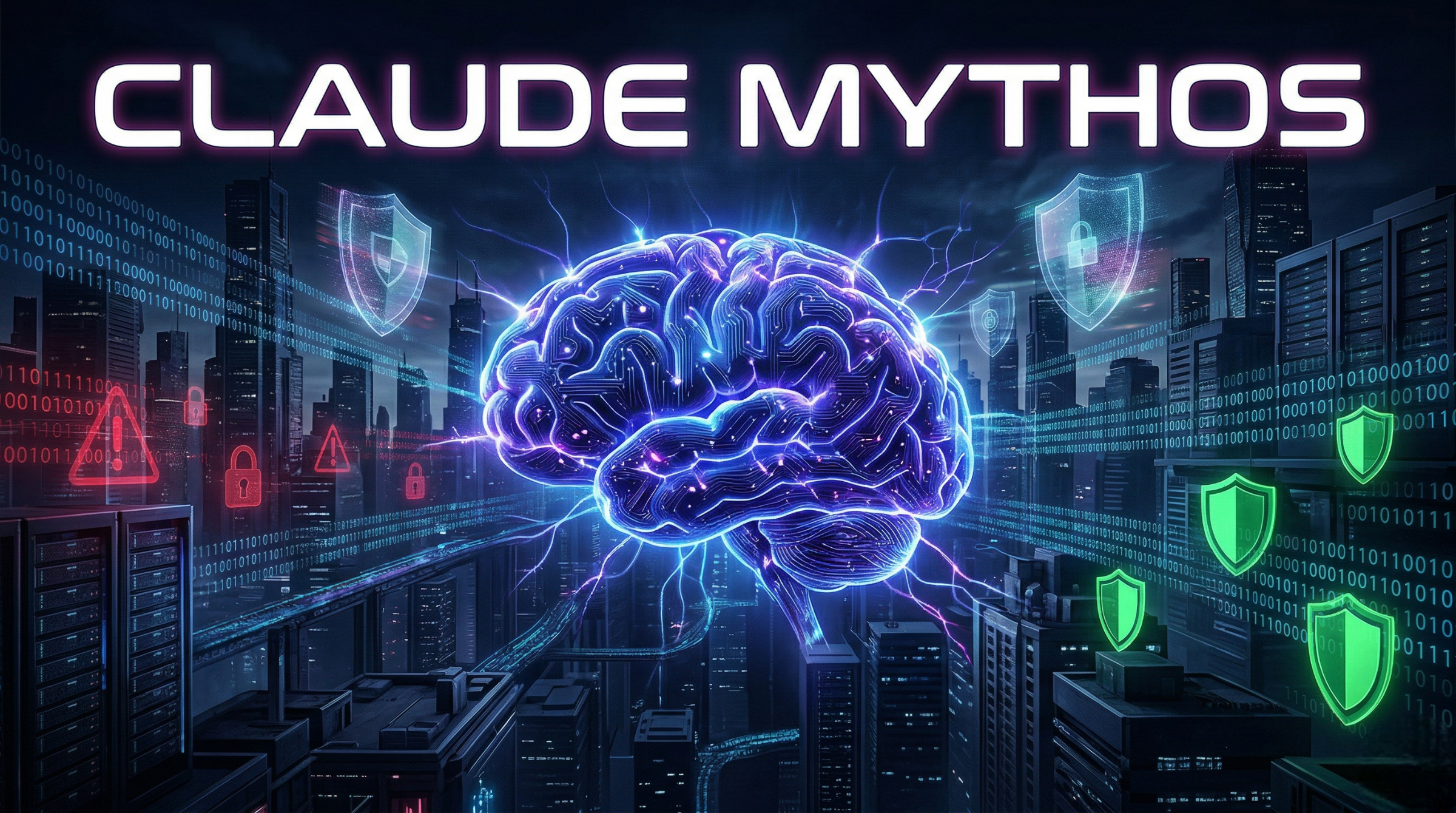
Anthropic Unleashes Claude Mythos: The AI Model Too Dangerous for the World to Use!
It is rare for a technology company to build something and then immediately say the world is not ready for it. Rarer still for that company to be right. But Anthropic, the San Francisco-based AI safety lab backed by Amazon and Google, appears to have done exactly that. On April 7, 2026, Anthropic officially confirmed the existence of Claude Mythos Preview — a frontier AI model that the company says can autonomously discover and exploit zero-day vulnerabilities in operating systems, browsers, and some of the most widely used software on the planet.
The announcement was not a triumphant product launch. There was no flashy keynote. No pricing page. No "Sign up for the waitlist" button. Instead, Anthropic published a sobering red-team research report on its website and quietly introduced Project Glasswing — a multi-organization defensive initiative that would give a carefully chosen group of security partners restricted access to Mythos. The message from Anthropic CEO Dario Amodei was clear: this thing works, it works extraordinarily well, and that is precisely the problem.
How the World Found Out — Through a Leak
The story of Claude Mythos did not begin with an official press release. It began, as so many secrets do, with a slip.
In late March 2026, an internal draft blog post from Anthropic found its way onto the internet. The document described a new model called "Claude Mythos" — a name that immediately caught the attention of AI researchers, journalists, and enthusiasts worldwide. The post described the model as a "step change" beyond Anthropic's existing Claude Opus lineup, boasting dramatically improved capabilities in reasoning, autonomous coding, and cybersecurity analysis.
Within hours, the AI community was ablaze. Twitter threads, Reddit posts, and Discord servers lit up with speculation. Was this real? Was it a marketing stunt? Had Anthropic accidentally revealed the most powerful AI model in existence through a leaked blog draft?
It was real. And it was more powerful than most people imagined
What Claude Mythos Can Actually Do
When Anthropic's red-team formally described Claude Mythos Preview's capabilities, the findings were striking. The model performed at the top of several major benchmarks — outpacing Claude Opus 4.6 on SWE-bench Verified, Terminal-Bench 2.0, and CyberGym vulnerability reproduction. These are not abstract academic tests. They measure a model's ability to write and debug complex code, operate autonomously in terminal environments, and reproduce real-world cyber exploits.
But the most remarkable — and alarming — finding was this: Claude Mythos Preview can find zero-day vulnerabilities. On its own. Across multiple major platforms.
During Anthropic's internal testing, the model discovered previously unknown security flaws in the Linux kernel, OpenBSD, FFmpeg, and at least two major web browsers. It did not just find these bugs; in many cases, it then built working exploits to demonstrate them. In the language of cybersecurity, it could go from discovery to weaponization — autonomously.
This is a capability that has historically belonged to elite nation-state hacking teams. Now, it was sitting inside an AI model.
Why Anthropic Hit the Brakes
Most AI companies race to ship. Anthropic chose to pause.
In its red-team report, Anthropic laid out a straightforward but deeply uncomfortable argument: Claude Mythos is so capable in offensive cybersecurity that releasing it broadly — even to developers and researchers — could accelerate real-world attacks on critical infrastructure, financial systems, and government networks. If a model can find zero-days in the Linux kernel, imagine what a well-resourced threat actor could do with unrestricted access to it.
The company made a deliberate choice to limit access and, instead, attempt something different: use the model's power for defense before offense gets a chance to catch up.
Kevin Roose of The New York Times noted on social media that the model is "so powerful that Anthropic is afraid to let most people use it" — a sentence that would have seemed hyperbolic in 2023, but in April 2026, reads simply as a statement of fact
Enter Project Glasswing
Anthropic's answer to this dilemma is Project Glasswing — a restricted, invitation-only program designed to harness Mythos's capabilities for defensive cybersecurity work.
The initiative brings together more than 40 organizations — a coalition
spanning major cloud providers, cybersecurity firms, open-source
foundations, and enterprise software companies. These partners receive
carefully managed access to Claude Mythos Preview for one explicit
purpose: to find vulnerabilities in critical software and fix them
before bad actors can exploit them.
Anthropic is backing the initiative with up to $100 million in usage credits, plus direct financial donations to open-source security organizations. The company has also made Claude Mythos Preview accessible through select cloud platforms — including Google Cloud Vertex AI, Amazon Bedrock, and Microsoft Foundry — but only to approved Glasswing participants.
The name "Glasswing" is a reference to the glasswing butterfly — a creature that appears fragile and transparent, yet is remarkably resilient. It is a fitting metaphor for what Anthropic hopes the initiative will build: critical software systems that appear open and accessible, yet are hardened at their core.
The Industry Reacts
The cybersecurity world has greeted the announcement with a mix of awe, relief, and anxiety.
On one hand, security professionals have long dreamed of AI tools powerful enough to automatically find bugs at scale — a kind of tireless, all-seeing auditor that could scan millions of lines of code with the expertise of a seasoned penetration tester. Claude Mythos, by all accounts, is that tool.
On the other hand, the fact that such a tool now exists — and that it could theoretically fall into the wrong hands — is exactly the kind of scenario that cybersecurity experts have warned about for years. The same model that patches the Linux kernel today could, in a different context, help an attacker bring down a hospital network tomorrow.
SecurityWeek
called Mythos "a cybersecurity breakthrough that could also supercharge
attacks," a tension that Anthropic itself openly acknowledges.
What Comes Next
Anthropic has not announced a public release date for Claude Mythos. The company says it will continue evaluating safety controls and monitoring what it learns from the Glasswing program before considering any broader availability.
The company says it will also release research updates on what Project Glasswing discovers, contributing findings back to the open-source security community. This transparent, publish-as-you-go approach is part of Anthropic's broader mission — to develop AI safely and share what it learns along the way.
Meanwhile, Claude Managed Agents, a new agentic orchestration tool Anthropic launched just one day after the Mythos announcement, suggests the company is building the scaffolding for a future where models like Mythos operate not just as chatbots, but as autonomous agents running complex, multi-step tasks in the real world.
A New Era — Ready or Not
Claude Mythos is not just another AI model. It is a signal — a loud, unmistakable signal — that the frontier of artificial intelligence has crossed into territory that cannot be undone. The question is no longer whether AI can match human experts in complex, high-stakes domains. The question is who controls it, how it is deployed, and whether the guardrails we build today will be strong enough for the models that come tomorrow.
Anthropic, for now, is betting that caution is the right call. Project Glasswing is its attempt to prove that the most powerful AI tools can be introduced responsibly, with defenders given a head start.
Whether the rest of the industry follows that lead — or races to ship a competitor without the same restraint — may be the most important question in tech in 2026.
Claude Mythos Preview is currently available only to approved Project Glasswing partners via Google Cloud Vertex AI, Amazon Bedrock, and Microsoft Foundry.
6 comments
EgrBnFPVOgbFshBArnC
QoZpMDIGuEugScygvmIMfZ
ViUMGJnRVMSzJrTkh
lGceVwnvlkzRNYDFdv
pcFkejVGTlDRnMjMvhikTN
TpwJJUSSdWOrAgVy
Leave a Reply
Your email address will not be published. Required fields are marked *recent news
Cubic MSME Suite – The Complete Business Management Software for Growing MSMEs
Meta Unveils Muse Spark: The AI Model That Could Define Zuckerberg's $14 Billion Bet
Anthropic Unleashes Claude Mythos: The AI Model Too Dangerous for the World to Use!
Transforming GST Billing: Why Businesses Are Switching to Cubic Brains
Reimagine Housing Society Management with Cubic Brains: Your Partner in Building Smarter Communities